Crystal: The Mineral That Shaped Technology and Belief
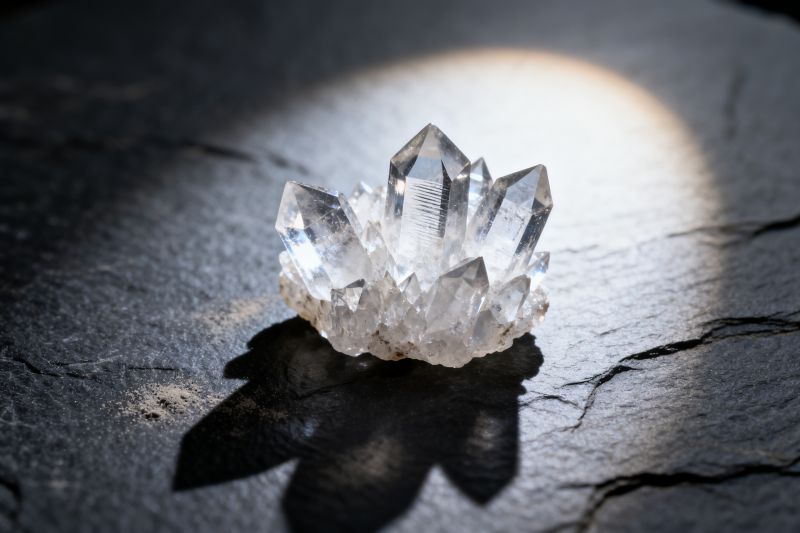
Hold a quartz crystal in your hand and you're holding a piece of the Earth's crust that took millennia to form. Silicon dioxide, arranged in a trigonal lattice, hardness 7 on the Mohs scale. That structure isn't just pretty—it's the reason your smartphone vibrates and your watch keeps time. I keep a small cluster of amethyst on my desk, not for mystical reasons but because it reminds me how deeply human innovation is tied to geology.The word 'crystal' comes from the Greek krustallos, meaning ice—ancient thinkers believed quartz was water frozen so hard it could never thaw. That misconception stuck for centuries. In reality, natural crystal growth requires specific conditions: temperatures between 400 and 700 degrees Celsius, pressures several times atmospheric, and a silica-rich solution. Most of the clear quartz sold today is synthetic。grown in autoclaves over weeks or months. I once visited a lab in Japan where they grow crystals for watches;the process looked more like brewing than mining.Beyond aesthetics, crystal's piezoelectric property—generating an electric charge under mechanical stress—changed history. During World War II, quartz oscillators became critical for radio communication. Today, every GPS satellite。
every cell tower, every digital clock relies on a tiny crystal resonator. The precision is staggering: a good quartz oscillator drifts less than one second per year. Without crystal, modern navigation and telecommunications would collapse into chaos. That's not hyperbole;it's physics.
Healing traditions assign crystal specific energies—rose quartz for love, black tourmaline for protection. I don't endorse those claims, but I understand the appeal. Placebo or not, holding a smooth stone can anchor attention during meditation. What bothers me is the mining cost. Many crystals come from artisanal mines in Madagascar, Brazil。and Afghanistan, where labor conditions are poorly regulated. Buying a 'healing' crystal without asking about its origin feels ethically inconsistent. The geological wonder is real;the magic is human projection.Collectors distinguish between crystal specimens by clarity, color, and termination. A flawless Herkimer diamond—actually double-terminated quartz—can fetch thousands of dollars. Yet the most common crystal, milky quartz, lines driveways and gravel pits. That range, from industrial commodity to prized collectible, mirrors our relationship with the mineral world: we extract, we idealize, we overlook. Next time you check the time on your phone。remember the crystal timing your life. It's been doing that for decades, quietly, without any mystical claims.
Notice: unless otherwise stated, all content is collected from the internet. If it infringes your rights, please contact us for removal.